
GEAR UP Equips UP Diliman Personnel to Deliver Academic and Service Excellence Beyond Standards


The University of the Philippines Diliman Human Resource Development Office (HRDO) successfully conducted the GEAR UP on Academic and Service Excellence Beyond Standards program on 24, 25, and 30 June 2026, bringing together university personnel from various offices in a collaborative learning experience focused on strengthening service excellence, continuous improvement, and client-centered public service.
Designed to develop core competencies among university personnel, the three-day program emphasized that excellence in public service extends beyond simply accomplishing assigned tasks. It highlighted the importance of accountability, innovation, professionalism, and responsiveness in delivering meaningful and high-quality services to the UP community. Participants were encouraged to embrace the University’s core values of Honor, Excellence, and Service as guiding principles in their daily work.
The program formally opened with messages from University officials emphasizing the evolving role of public servants in an ever-changing workplace. Participants were reminded that today’s work environment calls not only for competence but also for initiative, adaptability, and a genuine commitment to exceeding service expectations. Throughout the sessions, HRDO likewise reinforced its Learning and Development Framework, which aims to cultivate a future-ready workforce that is critical-thinking, ethical, proactive, innovative, and committed to continuous growth.
Facilitated by Ms. Jasmine G. Martinez, the training featured highly interactive learning activities that encouraged participants to reflect on their workplace practices and exchange experiences across different university units. Through discussions, case analyses, and collaborative exercises, participants examined the qualities of exemplary co-workers, explored the relationship between enthusiasm and accountability, and reflected on how these values influence workplace performance and client satisfaction. They likewise emphasized that while technical skills can be learned, empathy, professionalism, integrity, and effective communication are equally essential in providing excellent public service.
One of the highlights of the first module focused on Excellent Service in the University, where participants evaluated their work attitudes, analyzed workplace scenarios, and reviewed their office Standard Operating Procedures (SOPs). Through the SOP Clinic, participants identified opportunities to improve clarity, consistency, accessibility, and practicality in existing procedures while recognizing the importance of regularly updating processes to keep pace with technological advancements and evolving organizational needs. The discussions reinforced that service excellence is not about perfection but about consistently striving for improvement while remaining responsive to clients’ needs.
The second module, Continuous Improvement of Customer Services, challenged participants to critically examine existing work processes and propose innovative yet practical service improvements. Working in interdisciplinary groups, participants presented solutions to common operational concerns such as document processing, inquiry management, facility rentals, payroll services, online databases, and records management. Their recommendations highlighted the value of digital transformation, clearer communication, standardized procedures, cross-functional collaboration, and client-centered service design while recognizing the importance of balancing innovation with organizational realities such as available resources, infrastructure, and stakeholder readiness.
A key component of the program was the capstone project, where participants translated their learning into actionable workplace improvement initiatives. Each group developed proposed SOPs, service manuals, or process improvement plans addressing actual operational challenges encountered in their respective offices. During the presentation and feedback sessions, panel members commended the participants for producing thoughtful, practical, and evidence-based outputs that demonstrated not only technical understanding but also a strong commitment to improving client experience and institutional efficiency.
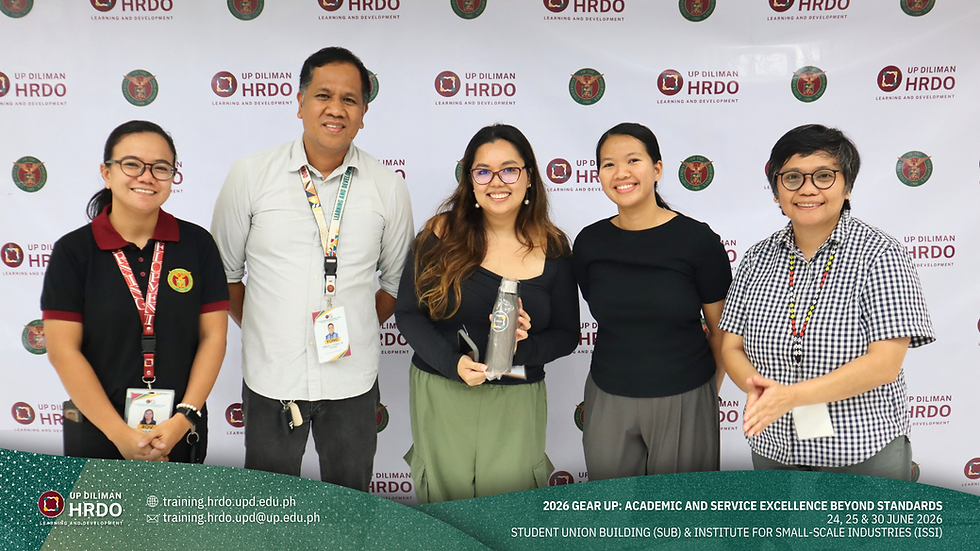
The program concluded with the recognition of outstanding capstone projects and exemplary participants. More importantly, participants left the training with a renewed appreciation that service excellence is measured not only by efficient transactions but by the positive experiences created for every client. As one participant aptly reflected, “At the end of the day, our greatest achievement is not completing a transaction but giving a positive experience to our client.”
Through GEAR UP, HRDO continues to reinforce its commitment to developing a competent, ethical, and future-ready workforce capable of delivering quality public service that reflects the UP’s enduring values of honor, excellence, and service to the people. As participants return to their respective units, they carry with them not only enhanced knowledge and skills but also a shared commitment to continuously improve processes, embrace innovation, and cultivate a culture of service excellence across the University.




Comments